


Introduction
For many years, business leaders have viewed sustainability and profitability as competing priorities. While most organizations recognized the importance of sustainable business practices, there was a widespread concern that incorporating sustainability into corporate strategy would increase costs and adversely affect profitability. Consequently, protecting the bottom line often took precedence over environmental and social considerations.
Over the past decade, however, this perception has changed significantly. Businesses across industries have demonstrated that sustainability and profitability are not mutually exclusive; rather, they are complementary objectives that can reinforce one another. Organizations that integrate sustainability into their business models often benefit from greater operational efficiency, enhanced brand value, stronger stakeholder trust, and improved long-term financial performance.
Today, environmental sustainability has evolved from being a peripheral concern to becoming a core element of business strategy. As awareness of environmental challenges continues to grow, companies are increasingly adopting sustainable practices and energy-efficient operations. Despite this shift, many business leaders still perceive sustainability initiatives as costly, complex, and difficult to implement. In reality, sustainability is increasingly proving to be a catalyst for innovation, resilience, and sustainable growth.
Current Trends: The Growing Business Case for Sustainability
Environmental sustainability has moved beyond the realm of regulatory compliance and corporate responsibility to become a strategic business imperative. Organizations are recognizing that sustainable practices not only reduce environmental impact but also enhance operational efficiency, strengthen competitiveness, and improve long-term resilience.
This shift reflects a growing understanding that environmental stewardship and business success are closely interconnected. Companies that optimize resource utilization, improve energy efficiency, and adopt sustainable operating practices are often better equipped to manage future uncertainties, reduce costs, and create lasting value.
A common misconception is that sustainability initiatives are expensive, time-consuming, and difficult to implement. However, experience across industries has shown that sustainability often generates significant business benefits by driving innovation, improving resource efficiency, strengthening customer loyalty, and enhancing corporate reputation. Rather than being a cost burden, sustainability has become a key enabler of long-term growth and business continuity.
The increasing importance of sustainability is also reflected in changing consumer and workforce expectations. Surveys conducted by global institutions, including the World Economic Forum, indicate that younger generations increasingly prefer to engage with organizations that demonstrate a strong commitment to environmental and social responsibility.
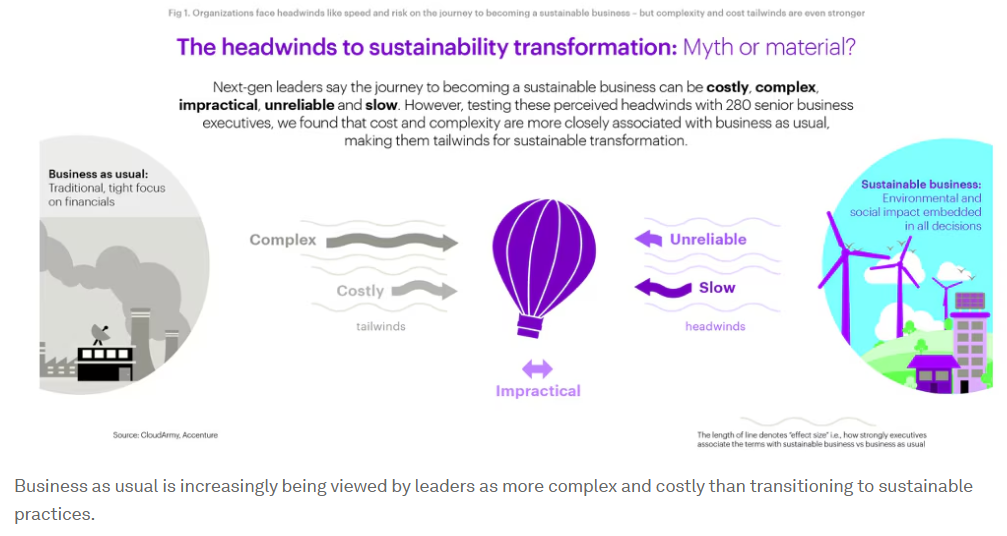
Source – A report from the World Economic Forum.
Leading Global Companies Successfully Integrating Sustainability and ESG
Over the past decade, sustainability has evolved from a corporate responsibility initiative into a core business strategy. Leading global organizations have demonstrated that integrating Environmental, Social, and Governance (ESG) principles into their operating models can create long-term value while strengthening competitiveness and resilience.
Several multinational corporations have successfully embedded sustainability into their business strategies and transformed their operating models to align with environmental and social objectives.
Siemens AG
Siemens, a global technology leader in healthcare, mobility, and infrastructure, has placed sustainability at the centre of its growth strategy. The company focuses on developing resource-efficient, resilient, and intelligent solutions for cities, transportation systems, and healthcare services. Siemens has consistently been recognized as one of the most sustainable companies in its sector and was among the first major industrial corporations to commit to achieving climate neutrality by 2030.
H&M
Global fashion retailer H&M has made significant investments in circular economy initiatives. Through innovations such as its fabric recycling technology, the company is working to increase the use of recycled materials across its product portfolio. H&M has also integrated circular design principles into product development by utilizing recycled textiles, plastics, and agricultural waste, supporting its long-term objective of achieving a fully sustainable supply chain.
Puma
Puma has established sustainability as a key pillar of its corporate strategy. The company has adopted Science-Based Targets initiatives (SBTi) to meet its climate commitments and has focused extensively on sustainable sourcing practices. A significant proportion of its cotton and polyester requirements are sourced from sustainable suppliers, helping reduce its environmental footprint while strengthening supply chain resilience.
Adidas
Adidas has been a pioneer in sustainability within the sporting goods industry. Through its “Green Company” programme and participation in Science-Based Targets initiatives, the company has significantly reduced carbon emissions, water consumption, waste generation, and paper usage. Its long-term vision includes eliminating plastic waste from its operations and products while promoting circularity throughout the value chain.
Unilever
Unilever has integrated sustainability into its business model and long-term growth strategy. The company has committed to achieving net-zero emissions by 2039 and actively collaborates with suppliers to improve carbon transparency throughout its supply chain. In addition, Unilever invests in initiatives focused on water conservation, biodiversity protection, carbon sequestration, landscape restoration, and reforestation, reinforcing its commitment to sustainable development.
Sustainability: A Strategic Business Imperative
Today, sustainability has gained widespread acceptance across the corporate world. While sustainability initiatives may not always result in immediate increases in profitability, they create significant long-term value by improving operational efficiency, strengthening resilience, enhancing brand reputation, and reducing business risks.
Importantly, sustainability is no longer the exclusive domain of large corporations. Small and medium-sized enterprises (SMEs) can also begin their sustainability journey by embedding environmentally responsible practices into their organizational culture and operations.
Organizations can take several practical steps to initiate their sustainability efforts, including:
- Waste reduction and recycling programmes
- Water conservation and recycling initiatives
- Adoption of renewable energy sources
- Circular use of raw materials and resources
- Sustainable sourcing and supply chain practices
The benefits of these initiatives accumulate over time, enabling businesses to better withstand future environmental, economic, and regulatory challenges.
Strategic Benefits of Sustainability and ESG
Organizations that integrate sustainability and ESG principles into their corporate governance framework and long-term strategy can realize several significant benefits:
1. Enhanced Business Resilience and Innovation
Sustainability enables organizations to respond more effectively to fluctuations in resource availability, energy costs, and market conditions. It also drives innovation by encouraging the redesign of products, services, and business processes, often resulting in improved efficiency and profitability.
2. Reduced Waste and Improved Resource Efficiency
Sustainable operating practices promote the efficient use of resources, waste minimization, and the adoption of renewable alternatives. These measures not only reduce environmental impact but also lower operating costs over time.
3. Stronger Brand Reputation and Customer Loyalty
Consumers are becoming increasingly conscious of the environmental and social impact of the products and services they purchase. Organizations that demonstrate a genuine commitment to sustainability often enjoy stronger customer trust, greater brand loyalty, and enhanced market differentiation.
4. Better Regulatory Preparedness
Environmental and sustainability-related regulations continue to evolve across global markets. Companies that proactively adopt ESG frameworks are better positioned to meet future compliance requirements and adapt to changing regulatory expectations.
5. Increased Investor Confidence
Investors are increasingly incorporating ESG considerations into their investment decisions. Organizations with strong sustainability credentials are often viewed as lower-risk, forward-looking businesses capable of generating sustainable long-term returns.
ESG as a Pillar of Corporate Governance
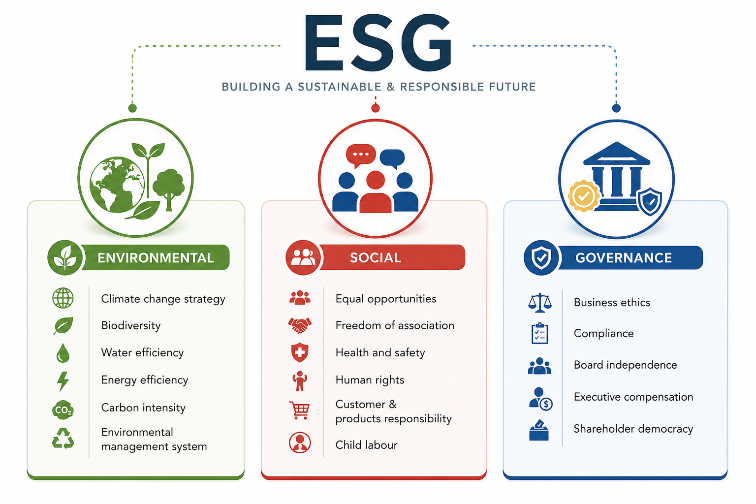
Environmental, Social, and Governance (ESG) principles provide a comprehensive framework for evaluating an organization’s sustainability performance and ethical conduct.
Environmental
Environmental factors assess how effectively an organization manages its impact on the natural environment. These include carbon emissions, energy consumption, resource utilization, waste management, pollution control, and environmental conservation initiatives.
Social
Social factors evaluate an organization’s relationships with its stakeholders, including employees, customers, suppliers, and local communities. Key considerations include workplace safety, diversity and inclusion, human rights, employee well-being, labour practices, and customer satisfaction.
Governance
Governance factors focus on the systems, structures, and processes that guide corporate decision-making. These include board composition and independence, executive compensation, ethical business conduct, regulatory compliance, transparency, accountability, and shareholder rights.
Together, these three pillars provide organizations with a robust framework for achieving sustainable growth, responsible business conduct, and long-term value creation for all stakeholders.
Conclusion
The debate between sustainability and profitability has evolved significantly over the past decade. What was once perceived as a trade-off is now increasingly recognized as a strategic partnership. Businesses across industries have demonstrated that sustainability is not merely a compliance requirement or a corporate social responsibility initiative; it is a powerful driver of long-term value creation.
Organizations that embed sustainability and ESG principles into their business strategies are better positioned to manage risks, improve operational efficiency, attract investment, strengthen brand reputation, and respond effectively to changing market expectations. While the financial benefits of sustainability may not always be immediate or directly visible in quarterly results, they create a resilient foundation for sustained growth and competitiveness.
The future belongs to organizations that can balance economic success with environmental stewardship and social responsibility. Companies that proactively embrace sustainability today will not only contribute to a better world but will also build stronger, more agile, and more profitable enterprises for tomorrow.
For modern leadership, therefore, the question is no longer whether to choose sustainability or profitability. The real challenge is how to leverage sustainability as a catalyst for achieving enduring profitability and long-term business success.